1 · Pick your creek — the gauge runs the decision
Erie steelhead fishing is a flow-and-color game. Rain raises the creeks and pushes fresh fish in; the creeks then fall and clear at different speeds, and each one has a window where it fishes best. You don't guess at this — the USGS gauges tell you. Two of the three big creeks have real gauges. Elk doesn't, and this pack tells you exactly how we read it anyway.
The color ladder (the same water reads the same way on all three creeks): gin clear (visibility 4 ft+ — fish spooky, hold deep and shaded) → clear green (2–4 ft — comfortable fish, strong all-around water) → green / lightly stained, the "magic green" (roughly 18–30 inches of visibility — prime: enough stain that fish feel covered and feed, enough visibility that they can find your offering) → milky (8–18 in — fish hug soft seams and bank edges) → chocolate (under 8 in — blown out; wait for the drop). And the rule that rides on top: falling water beats rising water at the same color — a creek dropping into green is the best water in Erie.
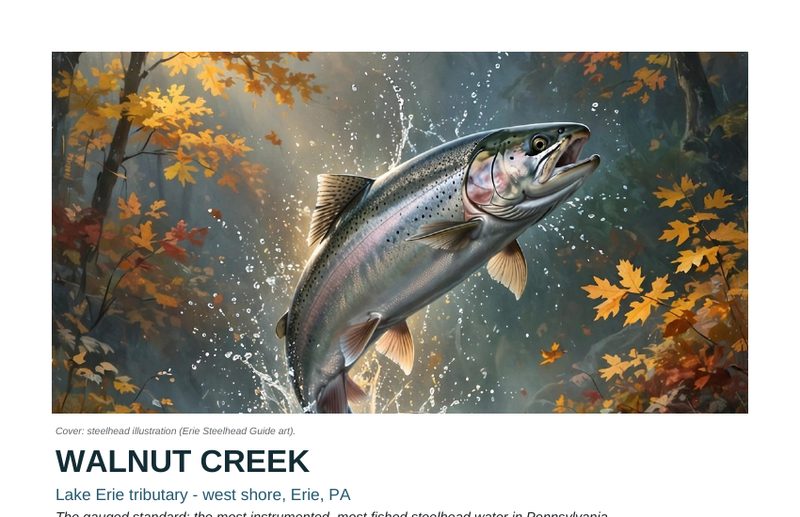
The gauged standard
Walnut Creek
The most heavily fished water in Pennsylvania steelheading, and the best-instrumented: USGS gauge 04213152 sits at the mouth pool and reports flow, height, temperature and turbidity. A medium, rocky basin (37.3 sq mi at the gauge) that clears faster than the other Erie streams — Walnut greens up first after rain, often while Elk and the east side are still milky. Mid-October median flow is 18 CFS, so single digits mean a waiting game: fish stage at the mouth and in the lake.
Flow bands (CFS, gauge 04213152):
Too low: under 15 · Low-fishable: 15–50 · Prime: 50–150, falling and green · High-fishable: 150–250 and falling · Blown out: over 250, or rising and chocolate.
Fish it when: it's the first creek in shape after rain (plan on 1–2 days to fishable after a real event) and the low-water address at its mouth pool. The trade-off is pressure — the famous lower pools are the busiest water on the shore.
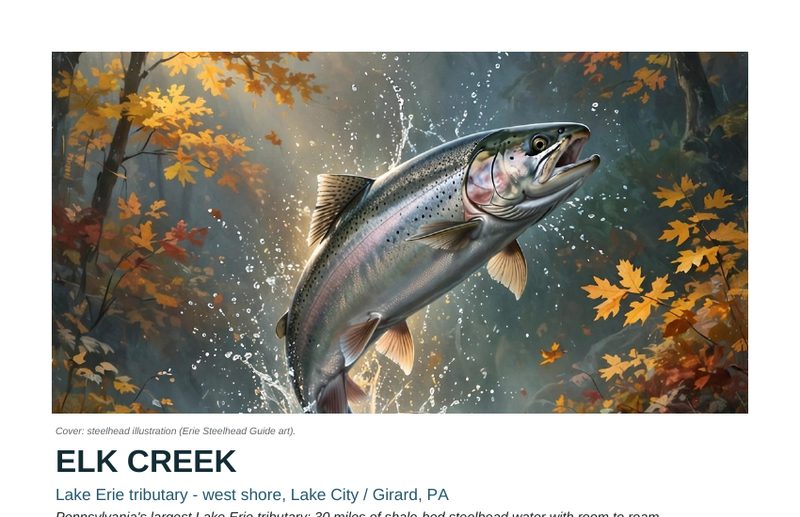
The main event
Elk Creek
Pennsylvania's largest Lake Erie tributary — about 99 sq mi of basin and 30 miles of creek, slow-to-moderate gradient over shale, with no falls or real barriers in the lower river. On good water steelhead push far upstream — fish have been caught 10–12+ miles up. There is no gauge on Elk Creek itself. The working proxy is USGS 04213075 on Brandy Run, a small Elk tributary near Girard: a headwater signal, read for its trend and relative level, with color confirmed at the access.
Flow bands (CFS, Brandy Run proxy — estimates, not main-stem measurements):
Too low: under 2 · Low-fishable: 2–4 · Prime signal: 4–10 and falling · High-fishable: 10–20 · Blown out: over 20.
Fish it when: the shale bed sheds mud instead of holding it, so Elk starts fishing 36–48 hours after high water — sooner than its size suggests. When Elk is magic-green while everything else is still milky, that's why. It's the room-to-fish creek: minutes of walking buy solitude Walnut can't offer.
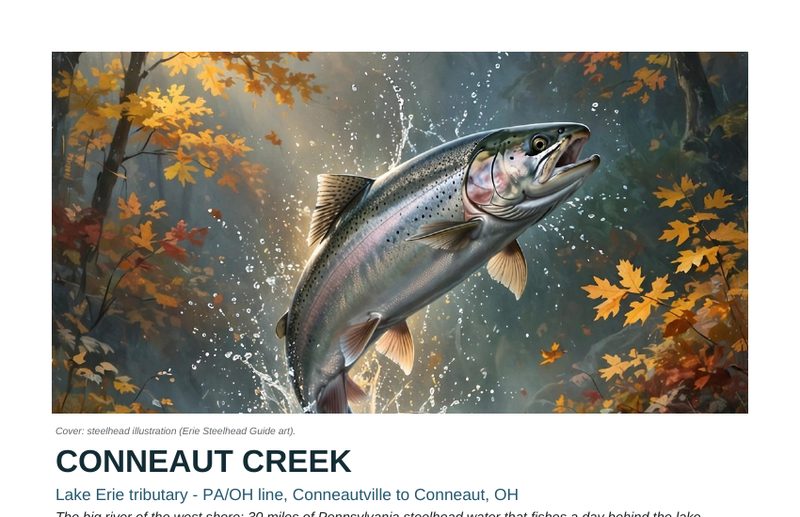
The big western bookend
Conneaut Creek
The largest watershed of the three — 175 sq mi at the gauge — spanning the PA/OH line, with real gauge USGS 04213000 at Conneaut, Ohio. Big, slower water over a rocky bottom. It rises big and stays up longest — plan on 2–4 days to fishable after a real rain event — but once it starts dropping, the rocky bottom clears it faster than its size suggests, and when Conneaut is green it stays green-and-fishable longer than any other trib. That's the payoff for waiting. For scale: mid-October median flow is 27 CFS, and recent readings around 21 CFS sit at the very bottom of its low band — a NO-GO in practical terms until rain builds it.
Flow bands (CFS, gauge 04213000):
Too low: under 20 · Low-fishable: 20–50 · Prime: 50–200 · High-fishable: 200–450 and falling · Blown out: over 450.
Fish it when: Walnut has been fished out or blown through. Conneaut fishes days behind Walnut — when the east side blows out and drops, Conneaut is just coming in. Two states' licenses meet on this river: know which side of the line you're fishing.
The quick call
Which creek, which day
Rain just ended / everything blown: nobody fishes well. Watch the gauges and be first back as they fall.
First fishable water: Walnut — it greens up first.
A day or two into the drop: Walnut in its prime band; Elk's prime signal (Brandy Run 4–10 and falling) switches on at 36–48 hours.
Late in the cycle: Conneaut — still green and fishable when the others have dropped out or been combed over.
Dry spell / everything low and clear: fish the mouths and the lake edge at first light — Walnut's mouth pool is the classic address. Downsize everything and fish the deepest slots.
Bands above are Erie angler working bands anchored to the USGS gauge statistics for each station — working numbers, not instrument readings. Live figures are provisional USGS data. The full per-creek playbook — five flow bands with rigs, holds and timing for each — is in the Deep Dive guides below.
2 · Where to park & walk in
Three proven starting points per creek — public access and easements documented in the full guides. Erie banks are a patchwork of public water, easements and private land: fish only public access, easements and unposted water, and re-check posting every trip.
Walnut Creek
Start here on Walnut
Walnut Creek Marina & PFBC Access (the mouth) — the large PFBC lot at the marina, 241 Manchester Rd, Fairview: ramps and a fish-cleaning station, paved lot to the water's edge. The easiest arrival in Pennsylvania steelheading, with the USGS gauge at the upstream pool beside you. The low-water and early-season address. There's also a live camera at the access — check the lot and the mouth before you drive.
Dutch Road tubes (PFBC easement) — a small easement lot near the Dutch Road crossing, Fairview Twp, and a short walk to the tubes and mid-creek slots. A fraction of the mouth's pressure.
Asbury Woods & Bridger Park — park at Asbury Woods or Bridger Park (Millcreek Twp); a footpath from Bridger Park reaches easement-corridor water. An easy, family-friendly walk.
Know before you go: much of Walnut's bank is private, and the famous Manchester Hole reach has posted access restrictions — fish only where you are certain you are on public water or easement, and respect every posted sign.
Elk Creek
Start here on Elk
Elk Creek Access — Erie Bluffs State Park (the mouth) — state park lots off Route 5 in Lake City and an easy walk down to the lower river and mouth: the creek's first holding water and the starting point in every flow band.
North Creek Road — PFBC easement corridor — easement parking along North Creek Road with long public stretches on both banks around the former hatchery property. Long walks available in both directions — this is the room-to-fish water, and the pressure fix on crowded weekends.
Girard Borough Park — a municipal park lot in Girard, on the creek, with trails following the water. In-town pools and runs; steady, rarely elbow-to-elbow.
Know before you go: Elk has no public live camera — the Brandy Run gauge trend is your remote read, and the color gets confirmed standing at the access.
Conneaut Creek
Start here on Conneaut
Lower river & Conneaut Harbor (Conneaut, OH) — public lots and harbor access near the mouth: the easiest arrival on the river, and the USGS gauge is right here. The harbor water fishes when the upper river is still blown, and first on every drop.
Clover Road corridor (Ohio side) — small bridge pull-offs at North Akerley Road and Griffy Road, south off Clover Road, with well-known water a short walk from the bridges. Keep the pull-offs clean.
Route 6N bridge (west of Albion, PA) — the PA reach's center of gravity: classic runs and bends above and below the bridge, with the McKee Road crossing east of 6N as a second nearby option. Limited roadside parking. Pennsylvania water — PA license plus Lake Erie permit.
Know before you go: two states' licenses meet on this river — confirm which side of the line you're on before you rig up.
Before you fish
The honest fine print
Seasons, hours, creel limits and special-regulation water change — check the current PFBC summary book (and Ohio's regulations on the Ohio side of Conneaut) before you fish. Access changes too: easements get posted, lots close, restrictions go up after misconduct. The full guides track the access story creek by creek and update as it changes; this pack is the starting point, not the last word. Nothing here replaces reading the water in front of you.
3 · One starter rig — the float rig
One rig catches steelhead on all three creeks: a bait or egg offering drifted at current speed under a float, just off bottom, through the slots and pool tails. Build it in this order, top to bottom:
- Rod & reel: a 9–10 ft medium-light steelhead spinning rod — soft enough to protect light leaders, with enough backbone for creek fish — and a 2500/3000-size spinning reel with a smooth drag.
- Main line: 10–15 lb floating monofilament. Floating line rides high on the surface and mends clean, so the drift runs at current speed — that's the whole game.
- Micro swivel: a tiny, strong swivel between main line and leader. It kills the line twist a tumbling offering creates and keeps the drift drag-free.
- Leader: fluorocarbon, roughly 6 lb in clear water — near-invisible when the creeks run gin-clear and the fish are educated. Lengthen and lighten as the water clears; shorten as it stains.
- Float: a balsa float rated in grams, sized to the depth and current of the water you're fishing — smaller for Walnut's slots, bigger for Conneaut's slow pools. Shotted right, it tips at the lightest peck.
- Shot pattern: soft split shot pinched down the leader — the bulk of the weight grouped below the float, then progressively smaller shot tapering toward the hook. The taper is what makes the offering drift naturally: bait leads, float follows, nothing drags or swings.
- Hook & offering: a wide-gape, short-shank hook in the #8–#12 range. Start with the Erie staple — a dime-size egg sac or a single egg — fished on or near bottom.
- Setting the depth: slide the float stop until the offering rides just off bottom through the drift. If you're not occasionally ticking bottom, you're fishing over the fish; if you're dragging and snagging every cast, you're under them. Adjust in small moves.
That's the starter version. The full guides tune it creek by creek and band by band — what changes on Elk's long shale slots is not what changes in Walnut's engineered pools — and the fly version (an egg over a small nymph under an indicator) runs on the same drift logic.
4 · The daily conditions system — free, every morning
Picking the right creek is a daily call, and we make it every morning of the season so you don't have to rebuild it from raw gauge feeds:
- The morning card: a free email that lands before the drive — the day's measured rainfall, the live gauge readings on Walnut, Elk (Brandy Run) and Conneaut, and a plain per-creek GO / NO-GO verdict traced to that morning's numbers. No verdict we can't tie to a gauge.
- The CREEKS ranked order: on the day's Keystoned Steel post, comment CREEKS and we'll DM you the full ranked order — which creek fishes first, second, third — with the window hours for each, computed from the gauge trends. It's the answer to "okay, but where do I actually go today?"
- Live views where they exist: the daily report carries current frames from the Walnut Creek mouth camera and the Trout Run / Avonia Beach camera — and says so plainly for water with no camera, Elk included.
Get the free morning card →
See all the guides →
5 · Go deeper — the full playbooks
This pack is the first morning. The full guides are living editions — apps that update as conditions change, with live gauges and live weather & radar inside, the complete access roster with parking and walk-in detail, the five-band flow playbook for each creek, and the seasonal timing that takes years on the water to learn. Start with the creek you're standing on:
Deep Dive · $12.99
Walnut Creek Deep Dive
The full Walnut playbook: every access point with parking and walk-in detail, the run-by-run breakdown of where fish hold by flow and clarity, and the five-band plan built on the 04213152 gauge.
Keystoned Steel is a trade name of JS Power LLC. Payments are processed through JS Power LLC — your card statement will show JS Power LLC.
Deep Dive · $12.99
Elk Creek Deep Dive
The full Elk playbook: the Brandy Run proxy read done right, the easement corridors and the whole 30 miles of fishable water, and how to fish a big shale creek band by band.
Keystoned Steel is a trade name of JS Power LLC. Payments are processed through JS Power LLC — your card statement will show JS Power LLC.
Deep Dive · $12.99
Conneaut Creek Deep Dive
The full Conneaut playbook: both states' water, every crossing and access, and the timing skill — fishing the big river on its own slower clock — that makes it the late-cycle creek.
Keystoned Steel is a trade name of JS Power LLC. Payments are processed through JS Power LLC — your card statement will show JS Power LLC.
The Flagship · $24.99
Keystoned Steel — Flagship Living Edition
The whole Erie system in one living edition — every Erie tributary Deep Dive plus the flagship's lake and shore coverage, updating as the water changes. Buy it once; every update is free, forever.
Keystoned Steel is a trade name of JS Power LLC. Payments are processed through JS Power LLC — your card statement will show JS Power LLC.
Coming this week — the Season Pass, $34.99: every guide, all season long, through April 30, 2027. Watch the guides page and the morning card for the drop.